
Community-resilience approach to wildfire preparedness
This article was originally published in the September 2026 edition of the Heights Life magazine.
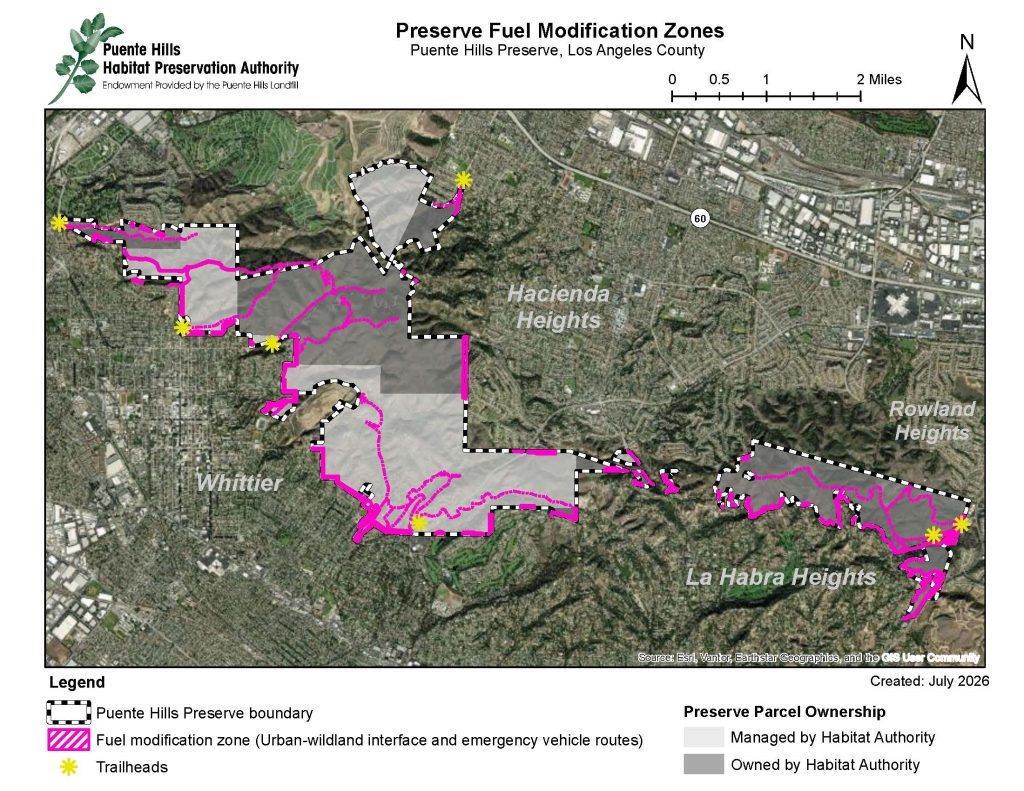
More than 500 acres of the total acreage managed by the Puente Hills Habitat Preservation Authority is located within La Habra Heights, primarily encompassing Powder Canyon. Numerous Heights homes are in close proximity to land managed by the Authority, which oversees some 3,870 total acres of public open space (see map below).
Wildfire preparedness is most effective when public agencies, land managers and residents all understand the important roles they play.
In keeping with this cooperative approach, the Authority conducts annual fuel clearance around the perimeter of the Puente Hills Preserve where open space meets neighboring homes, roadways and developed areas. This reduces hazardous vegetation that can carry wildfire and gives firefighters a safer area from which to defend neighborhoods, including those in La Habra Heights.
This past year, funding for this effort was from Measure PH, which voters approved in 2024. The Authority also received grant funds to clear regrowth at many of these areas in the wintertime.
This work is strategic—it goes beyond simply removing vegetation. Thoughtfully managing dry, invasive plants while supporting healthy native species helps protect habitat, stabilize soil and strengthen the Preserve’s long-term resilience.
Grant funding* also allowed the Authority to complete a facility hardening project this summer to help make structures and infrastructure more resistant to wildfire and wind-driven embers, which not only protects the improved structures but also reduces the likelihood that potential fires could spread to neighboring vegetation and homes. Particular attention was paid to Zone Zero, the area closest to a structure that is most vulnerable to embers and where combustible materials must be minimized.
Key elements of this project included:
• Removing wood fencing that was within five feet of the structure.
• Removing all vegetation within five feet and replacing it with gravel.
• Replacing vents and soffits with ⅛-inch mesh to stop embers.
• Relocating sheds and propane tanks to beyond 50 feet.
• Painting the structure with fire-retardant paint.
• Replacing a wood deck with fire-resistant materials.
• Removing nearby excessive vegetation and hazardous trees.
• Replacing curtains with fire-resistant vertical blinds.
• Upgrading the roof to the highest level of fire resistance.
These and other ongoing agency efforts support California’s Wildfire and Forest Resilience Action Plan for statewide community resilience through its three core strategic pillars: building the resilience of the built environment, advancing landscape-scale treatments and empowering local communities through capacity building and planning.
Community members are an important part of this shared effort. La Habra Heights residents can further reduce wildfire risk by performing low-cost retrofits on their properties, such as maintaining defensible space around their homes, restricting places where embers could enter and avoiding creating sparks—particularly when fire risk is high.
By staying informed and each doing our part, we can all help protect homes, neighborhoods, wildlife and treasured open spaces. The Habitat Authority remains committed to wildfire preparedness. For more information, please visit: habitatauthority.org/puente-hills-preservemanagement/wildfire-preparedness.
* Grant funds used were from the San Gabriel and Lower Los Angeles Rivers and Mountains Conservancy (RMC) for this Puente Hills Fire Resiliency project funded by the Safe Drinking Water, Wildfire Prevention, Drought Preparedness, and Clean Air Bond Act of 2024, and a grant through Caltrans sourced by Assembly Bills 178 and 179 sponsored by Assembly Member Lisa Calderon and State Senator Bob Archuleta.